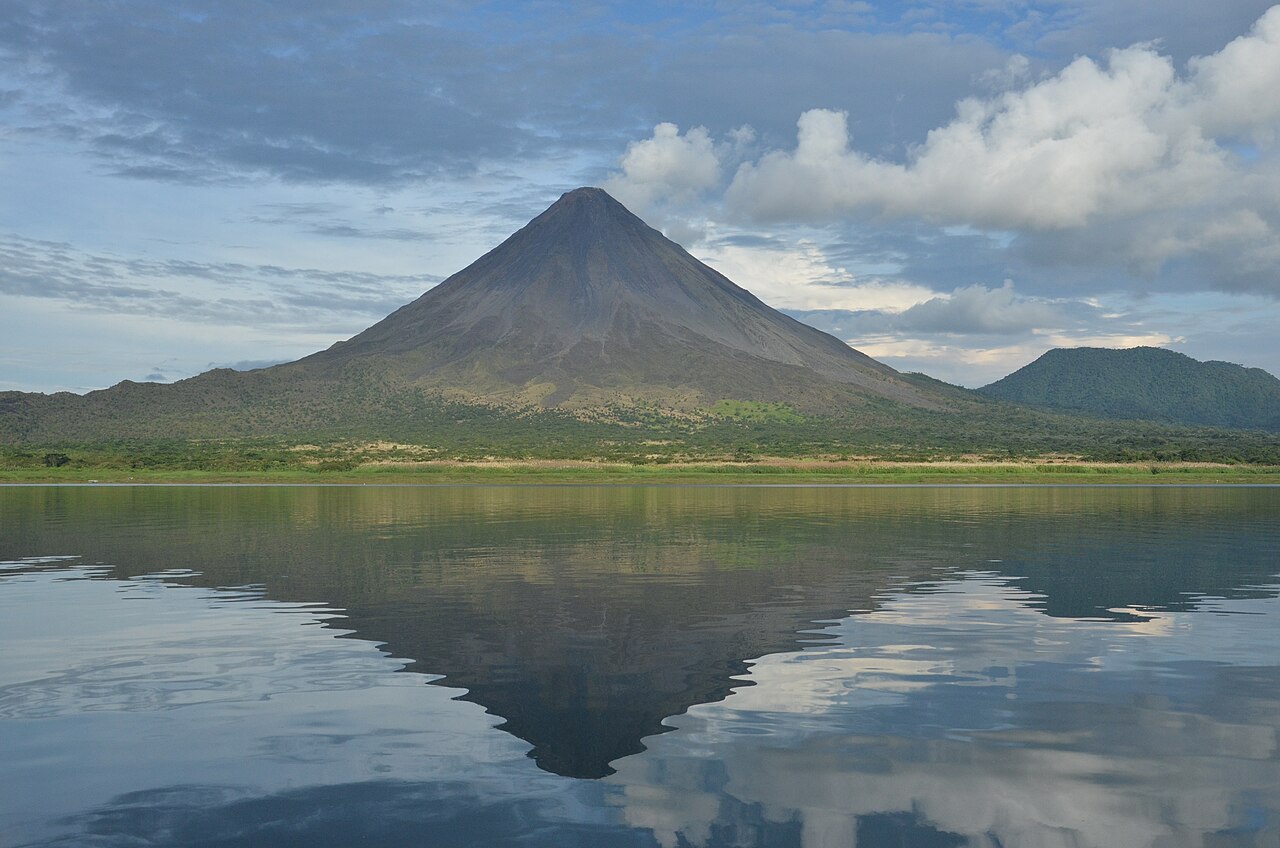
To the east, the dry plains of Guanacaste run up against the mountains, and beyond the volcanoes another Costa Rica begins, rainy and green all year, where pastures alternate with patches of humid forest and rivers run down from the volcanoes. Out there are two places that justify the hours in the car. The first is Río Celeste, a river so blue it looks retouched; the second is Arenal, the volcano with the almost perfect cone. One works as a day trip. The other doesn't.
Río Celeste: the waterfall, Laguna Azul and El Teñidero
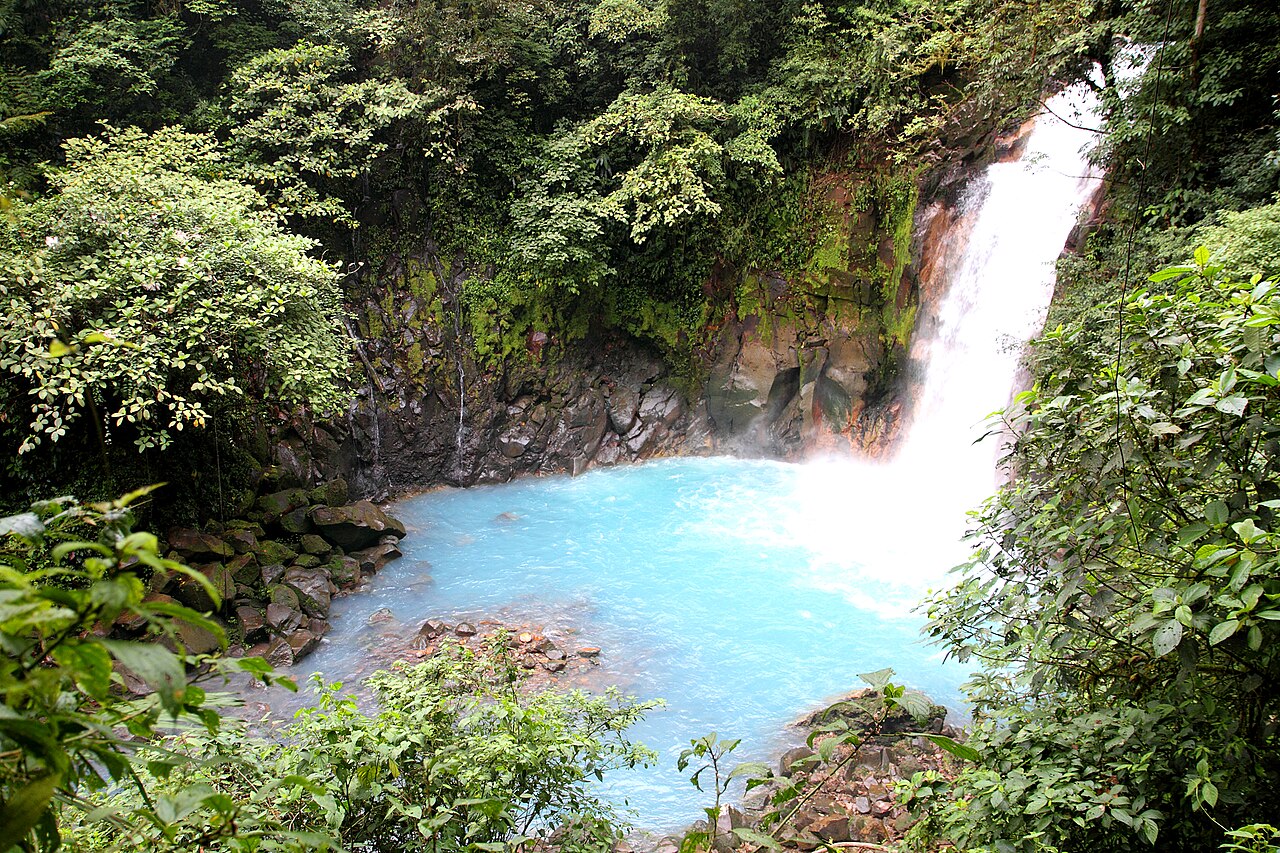
Río Celeste flows through Tenorio Volcano National Park. The trail, called Misterios del Tenorio, starts at the El Pilón station, which you reach from Bijagua de Upala on a paved road: from Ocotal it's more than two hours by car. About a kilometer and a half (1 mile) from the entrance is the waterfall, a drop of about thirty meters (100 feet) into a turquoise pool, reached by a long staircase down. Then you climb back up. Farther along you come to Laguna Azul, a small pool of an intense blue, then the Borbollones (“bubblings”), where hot gases from the volcano make the water bubble, and finally, about an hour's walk from the entrance, the Teñidero, the spot where the river “dyes” itself blue.
There's an explanation for the color. Where the Río Buena Vista meets an acidic stream, the Quebrada Agria, the chemistry of the water changes, and the tiny particles of aluminosilicates suspended in it grow just large enough to scatter sunlight and send it back blue: a study published in PLOS ONE in 2013 proved it. For years people said it was sulfur. Locals prefer another version. When God finished painting the sky, he washed his brushes in the river.
Arenal, the volcano that woke up in 1968
Before 1968 it was called Cerro Arenal, “Mount Arenal,” and it was considered extinct. On the morning of July 29, 1968, it exploded without warning and opened three craters on its western flank. The eruption buried three villages, Tabacón, Pueblo Nuevo and San Luis, and killed 87 people, and the volcano went on erupting for more than forty years. It has been quiet since 2010. Today it's a cone 1,633 meters (5,358 feet) high, mirrored in Lake Arenal, the largest lake in Costa Rica, which tripled in size in 1979 when a dam was built to produce hydroelectric power.
The base for a visit is La Fortuna, about fifteen kilometers (9 miles) from Arenal Volcano National Park, where trails cross the forest and old lava flows with the cone always in front of you, sometimes hidden by clouds. Nearby are the waterfall on the Fortuna River, about 70 meters (230 feet) high, and many hot springs heated by the volcano's hydrothermal system, most of them on private properties. Pack your swimsuit. On the western side of the lake a strong, steady wind blows from November to April, and many consider this shore one of the best places in the world for windsurfing and kitesurfing.
Planning: a day trip or a night away
Río Celeste works as a day trip if you leave at dawn: the round trip means more than four hours behind the wheel, and the trail takes at least a couple of hours. Arenal needs more than three hours just to get there. As a day trip, it isn't worth it. The most comfortable plan is a loop of two or three days: from Ocotal to Río Celeste by way of Bijagua, then on toward Guatuso and La Fortuna, one or two nights near Arenal, and the drive back along the lake toward Tilarán and Cañas, with the volcano in your rearview mirror.
If you only have time for one of the two, the choice depends on what you're missing. After days of sea and sun, Río Celeste takes you into the humid forest in just a few hours, among blue water and moss-covered rocks, while if you dream of seeing a volcano from your window as soon as you wake up, you need to go to Arenal and sleep nearby. We'd pick the river. And if you don't feel like driving, the villa can arrange a driver on request.
Leave from Ocotal, come back to Ocotal
Even when the trip takes two days, The White House Costa Rica is a convenient base: Liberia International Airport is about 30 minutes away, private parking is free and a driver is available on request. Christian, the host, helps you plan your excursions and transfers.